¶ Workforce Wellbeing Value
|
Workforce Wellbeing Value: Part of the TriValue Company model (TVC), Workforce Wellbeing Value focuses on creating an environment where individuals can thrive, adapt, and evolve in the face of disruption, complexity, and accelerated change. It emphasizes the importance of physical, emotional, and cognitive wellbeing, recognizing that a company’s ability to respond and innovate is directly tied to the health, safety, and adaptability of its people.
— Enterprise Agility University |
It's part of the TriValue Company model (TVC) and focuses on creating an environment where individuals can thrive, adapt, and deal with the challenges of a fast-changing business world. It recognizes that a company's success depends on its people's collective capabilities and ability to align and adapt to new realities. Workforce Wellbeing Value encompasses various dimensions that contribute to the overall wellbeing of individuals within the organization.
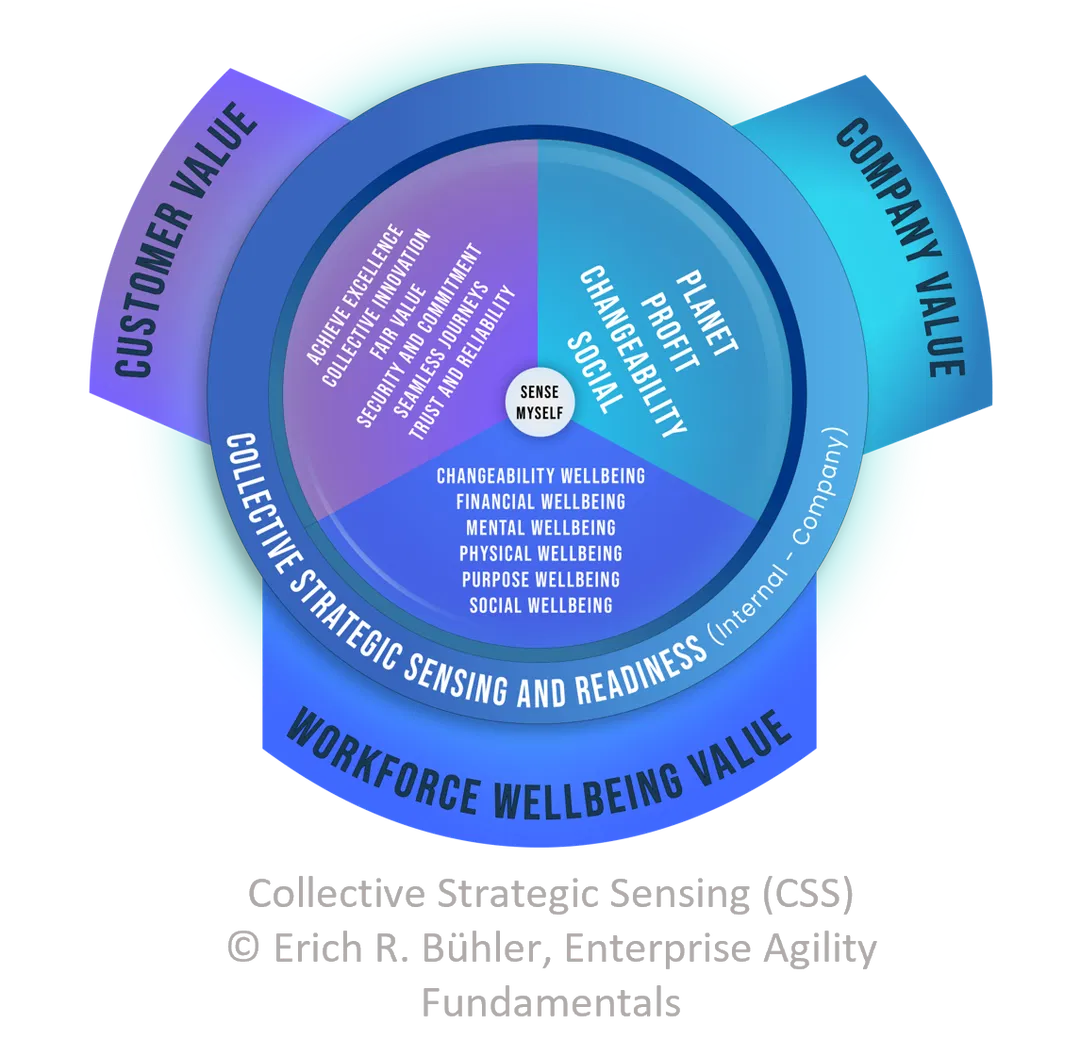
By prioritizing Workforce Wellbeing value, organizations can create a culture that supports their citizens in thriving amidst constant flux. It fosters resilience, meaning, and responsiveness, improving productivity, employee engagement, and retention.
For more detailed information about them, check Enterprise Agility Fundamentals, Chapter 8.
¶ Why is Workforce Wellbeing Value a Critical Concept When Exposed to High Uncertainty and Accelerated Change?
Constant disruption and accelerated change create significant stress on employees at all levels of an organization. The human brain and body are not designed to handle the pace and volatility of today's markets. This constant "fight or flight" response has real impacts on mental and physical health over time if not properly addressed.
As experienced change consultants, we have seen how neglecting workforce wellbeing during periods of uncertainty leads to decreased engagement, innovation, and overall performance. Employees who feel overwhelmed and unsupported will not be able to perform at their best.
However, organizations that make workforce wellbeing value a priority can build resilience and adaptability in the face of disruption. By providing resources for physical and mental health, encouraging social connections, aligning work to purpose, and giving employees a voice, companies empower their people to thrive amid uncertainty.
When you invest in workforce wellbeing value, employees feel valued and cared for. This leads to stronger loyalty, better retention, and a willingness to go the extra mile for the organization. Highly engaged, healthy employees directly contribute to a company's ability to quickly sense changes in the market and respond effectively.
In our experience, the most successful companies in volatile markets are those that recognize their people are their most important asset. Making workforce wellbeing a core value signals to employees that the company cares about more than just profits. It's about creating a nurturing culture where everyone can bring their best selves to work.
Leaders who embody compassion and invest in supporting their people will build an adaptive, resilient workforce able to constantly evolve. By caring for your employees as humans first, you empower them to care for your customers and drive innovation, ultimately fueling sustainable growth. Workforce wellbeing value is not just a "nice to have"—it's a competitive advantage in turbulent times.
For more detailed information about them, check Enterprise Agility Fundamentals, Chapter 8.
Spot indicators (list of Spot Indicators for the 3 types of value in TVC).
a) customer value has these spot indicators:
1.achieve excellence
2. collective innovation
3. fair value
4. security and commitment
5. seamless journeys
6. trust and reliability
b) company value has these spot indicators:
- planet
- profit
3.changeability
4.social
c) workforce wellbeing value has these spot indicators:
- changeability wellbeing
- financial wellbeing
- mental wellbeing
- physical wellbeing
- purpose wellbeing
- social wellbeing
¶ ✅ Why Workforce Wellbeing Value Is Critical in Exponential and Uncertain Environments
-
Buffers neurological stress responses: High uncertainty activates fear responses in the brain, narrowing attention and reducing problem-solving capacity. Prioritizing wellbeing reactivates prefrontal cortex function needed for strategic thinking.
-
Prevents disengagement and burnout: In volatile conditions, neglecting wellbeing leads to demobilization, turnover, and resistance to change.
-
Builds organizational readiness: A workforce that feels valued and cared for becomes more willing to take risks, speak up, and collaborate during change efforts.
-
Links directly to market responsiveness: Engaged, well-supported employees are more likely to detect weak signals, surface insights, and respond to shifting customer needs in real time.
-
Aligns with sustainable leadership models: Companies that value people over short-term profit send a signal of long-term trust and stability—key for attracting talent and retaining culture under pressure.
¶ ✅ Why Workforce Wellbeing Value Works
-
Supports adaptive capacity: When employees feel physically and psychologically safe, they are more capable of adjusting their behavior and learning during times of uncertainty.
-
Boosts resilience and emotional regulation: Wellbeing practices reduce chronic stress and cortisol levels, allowing people to sustain performance even under pressure.
-
Enables faster recovery after disruption: Individuals with higher wellbeing bounce back from organizational shocks more quickly, reducing long-term productivity losses.
-
Strengthens collective sensemaking: A healthy workforce is more open to diverse perspectives and better able to co-create solutions.
-
Enhances intrinsic motivation: When wellbeing is prioritized, employees experience more meaning and purpose, fueling long-term engagement and innovation.